
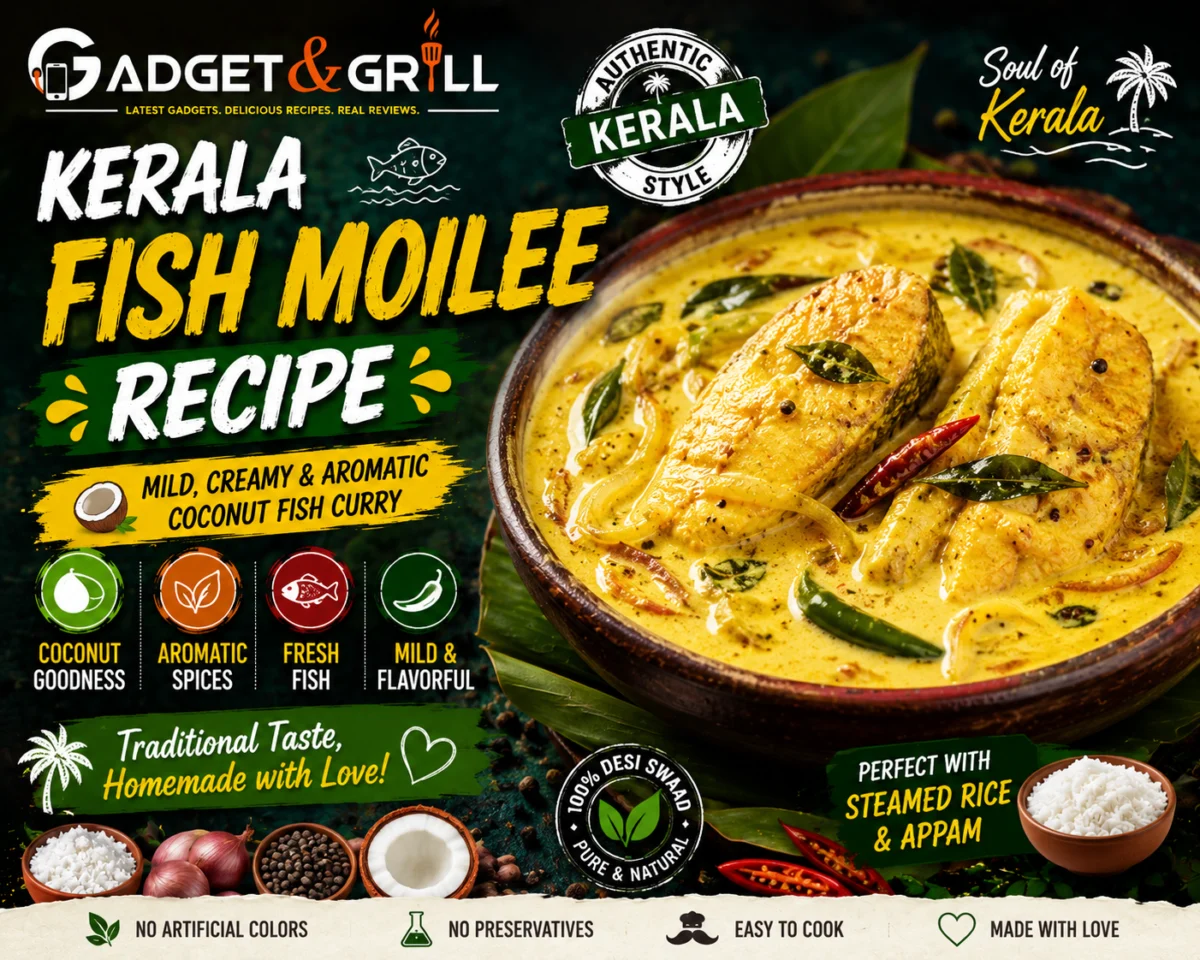
Most fish curries from Kerala hit you with heat first – a deep red gravy loaded with dried chillies, tamarind, and pepper that clears your sinuses before you’ve even finished the first bite. Fish Moilee does almost the opposite. It’s pale yellow, gently spiced, and built almost entirely around the sweetness of coconut milk, with just enough green chilli and black pepper to keep it interesting rather than fiery.
That restraint is exactly the point. This is a curry designed to let a good piece of fish speak for itself, poached gently in two stages of coconut milk rather than simmered hard in a spice-heavy gravy. Below is the full method – the light sear that keeps the fish intact, the two-milk technique that builds both body and richness, and the specific reasons a few small steps matter more here than in almost any other Kerala curry.
What Is Fish Moilee, and Why Is It So Different From Other Kerala Fish Curries?
Fish Moilee, known in Malayalam as Meen Moilee, is a coconut milk-based fish stew closely associated with Kerala’s Syrian Christian community, particularly in the coastal and central regions of the state. Unlike the fiery, tamarind-and-chilli-driven fish curries more commonly associated with Kerala, Moilee leans on green chillies and black pepper for its heat, keeping the overall flavour mild, creamy, and distinctly aromatic rather than sharp.
Food historians commonly trace the dish’s name and origin back to the Portuguese colonial period in Kerala, when a local cook – said to be named Molly or Moilee – was asked to prepare a fish dish for Portuguese settlers who found the region’s usual chilli-heavy curries too intense. The milder, coconut milk-based version she created is said to have become the basis of the dish now known across Kerala, and later carried further afield by British colonists and Malayali migrant communities into Malaysia and Singapore, where versions of it are still cooked today.
Why the Technique Here Is More Delicate Than It Looks
Fish Moilee has a short ingredient list and a short cooking time, but a handful of details are what keep the fish intact and the gravy silky rather than broken or watery.
A light sear before the fish ever meets the coconut milk
Briefly searing the marinated fish in coconut oil isn’t about cooking it through – it’s about firming up the surface just enough that the delicate flesh doesn’t flake apart once it’s simmered in the coconut milk gravy. Skipping this step often leaves fish pieces disintegrating into the curry by the time it’s done.
Two extracts of coconut milk, used at two different points
Thin coconut milk (the second extract, made from a second pressing of the coconut) is used to actually simmer and cook the fish, since it’s watery enough to poach gently without overwhelming the pot. Thick coconut milk (the first extract) is stirred in only at the very end, off the boil, to add the rich, creamy body that defines the dish – and folding it in only for the final minutes keeps its flavour bright rather than cooked out.
Never letting the coconut milk boil hard
Coconut milk is prone to splitting or curdling under strong, prolonged heat, particularly the richer, thicker extract. Keeping the flame low throughout, and especially after the thick milk goes in, is what keeps the gravy smooth and unified instead of oily and separated.
Swirling instead of stirring
Once the fish is in the pot, a spoon dragged through the gravy risks breaking the fish pieces apart. Gently swirling the pot itself distributes the coconut milk evenly around the fish without any direct agitation.
Ingredients (Serves 3-4)
Component A: Marination
- Fish fillets or steaks: 500 g (Kingfish, pomfret, or seer fish)
- Turmeric powder: 1/2 teaspoon
- Black pepper powder: 1/2 teaspoon
- Lemon juice: 1 tablespoon
- Salt: 1/2 teaspoon
Component B: Aromatic Base and Vegetables
- Coconut oil: 2 tablespoons, the traditional cooking medium
- Mustard seeds: 1/2 teaspoon
- Fenugreek (methi) seeds: 1/4 teaspoon
- Green chillies: 4-5, slit lengthwise
- Ginger: 1-inch piece, finely julienned
- Garlic: 5-6 cloves, thinly sliced
- Small onions or shallots: 1 cup, thinly sliced
- Fresh curry leaves: 2 sprigs
- Tomatoes: 2 medium, cut into thin wedges
Component C: Coconut Milk Base
- Thin coconut milk (2nd extract): 1.5 cups
- Thick coconut milk (1st extract): 1/2 cup
Step-by-Step Method
Phase 1: Marinate and Lightly Sear the Fish
- Wash the fish pieces thoroughly and pat them completely dry with paper towels.
- Mix the turmeric, black pepper, lemon juice, and salt into a paste, and coat the fish pieces evenly.
- Marinate at room temperature for 15-20 minutes.
- Heat 1 tablespoon of coconut oil over medium heat and lightly sear the fish for 1-2 minutes per side – the goal is only to firm up the surface, not to cook it through. Remove and set aside.
Phase 2: Temper and Saute the Aromatics
- Heat the remaining coconut oil in a clay pot (meen chatti) or deep pan over medium flame.
- Add the mustard and fenugreek seeds and let them crackle.
- Add the slit green chillies, julienned ginger, sliced garlic, and curry leaves, and saute for 1 minute until fragrant.
- Add the shallots with a pinch of salt, and saute on medium-low heat until soft and translucent – do not brown or caramelise them, since Moilee depends on a clean, light base.
Phase 3: Simmer the Curry
- Reduce the heat to low, pour in the thin coconut milk, and mix gently.
- Add a pinch of salt and bring the mixture to a very gentle simmer – never a vigorous boil, which can curdle the coconut milk.
- Carefully place the seared fish pieces into the simmering coconut milk.
- Arrange the tomato wedges around and over the fish.
- Cover and simmer gently on low heat for 8-10 minutes, until the fish is fully cooked and tender.
Phase 4: Finish With Thick Coconut Milk
- Remove the lid and turn the flame to its lowest setting.
- Gently pour in the thick coconut milk.
- Swirl the pot in a circular motion to mix it in, avoiding an aggressive spoon that could break the delicate fish.
- Let it heat through for 1-2 minutes without boiling, then turn off the heat immediately.
- Rest, covered, for 5 minutes before serving hot with appams, idiyappams, or steamed Kerala matta rice.
Tips for Getting It Right
- Choose a firm, meaty fish like kingfish, seer fish, or pomfret – softer, flakier fish is more likely to fall apart during simmering.
- Keep every stage of cooking on medium or low heat once the coconut milk goes in; high heat is the single most common cause of a split or oily gravy.
- Resist the urge to brown the shallots – Moilee is meant to taste clean and mild, and caramelised onions push the flavour toward a heavier, more standard curry base.
- If using homemade coconut milk, make the thick (first) extract by grinding fresh coconut with minimal water, and the thin (second) extract by re-grinding the same coconut with additional water.
- Let the finished curry rest for the full five minutes before serving – the flavours settle and the fish finishes gently cooking through in the residual heat.
Common Mistakes to Avoid
Fish Moilee has very few components, which means each one carries more weight than it would in a busier curry.
- Skipping the light sear, which often results in fish pieces breaking apart during the simmering stage.
- Letting the coconut milk boil hard at any point, which risks curdling or splitting the gravy.
- Browning the onions instead of cooking them until just soft, which changes the dish’s entire flavour profile.
- Adding the thick coconut milk too early, which cooks off its richness rather than preserving the creamy finish it’s meant to add at the end.
- Stirring the pot aggressively once the fish is in, which is the fastest way to end up with a curry full of broken fish flakes instead of intact pieces.
Regional and Ingredient Variations
While the core technique stays consistent, Fish Moilee varies noticeably by household and region. Some versions use a small amount of garam masala or extra black pepper for a slightly more pronounced warmth, while others stick strictly to turmeric, green chilli, and pepper for maximum mildness. Prawns are a popular substitute for fish in many homes, cooked using the same two-stage coconut milk method. A few coastal versions also finish the dish with a touch of vinegar or extra lemon juice for a brighter, tangier edge alongside the standard citrus in the marinade.
What to Serve With Fish Moilee
- Appam, the classic pairing – a soft, lacy rice-and-coconut pancake that soaks up the gravy beautifully
- Idiyappam (string hoppers), another traditional Kerala accompaniment
- Steamed Kerala matta rice for a heartier meal
- A simple side of thoran (a dry coconut-vegetable stir-fry) to round out a full Kerala-style spread
Storage and Reheating Notes
Fish Moilee is best enjoyed the same day it’s made, since coconut milk-based gravies can separate slightly on refrigeration and the fish can turn a little softer with extended storage. That said, leftovers keep for a day or two in an airtight container in the refrigerator. When reheating, do it gently on the stovetop over low heat, swirling the pot occasionally rather than stirring, and avoid letting it come to a full boil – the same rule that applies during the original cooking process applies just as much on reheat. A microwave can work in a pinch, but short bursts at lower power are safer than a single long blast, which is more likely to overheat and split the gravy.
A Note on Nutrition
Because the dish relies on coconut milk rather than cream, yogurt, or a heavy tempering of oil, Fish Moilee tends to be lighter than it tastes, while still delivering the natural fats that make coconut-based curries feel rich and satisfying. The fish itself contributes lean protein, and the minimal use of chilli powder and other ground spices means the dish is generally easier on the palate for those who prefer milder food, without sacrificing flavour depth. As with most coconut milk curries, portion size is worth keeping in mind if you are watching saturated fat intake, though an occasional serving fits comfortably into most balanced diets.
Frequently Asked Questions
Why does coconut milk curdle in fish curry?
Coconut milk can separate or curdle when it’s boiled too vigorously or for too long, particularly the richer, thicker extract, so keeping the heat low and gentle throughout – especially once the thick milk is added – is the main way to prevent it.
What is the difference between fish moilee and regular fish curry?
Regular Kerala fish curries typically rely on dried red chillies, tamarind, and a deep red, tangy gravy, while Fish Moilee is built around coconut milk with only green chillies and black pepper for heat, giving it a much milder, creamier, pale yellow profile.
What fish is best for fish moilee?
Firm, meaty fish like kingfish, seer fish, or pomfret hold together well through the searing and simmering process, making them better suited to the dish than softer, flakier varieties that are more prone to breaking apart.
Where does the name Moilee come from?
The name is widely believed to trace back to a Keralite cook, said to be called Molly or Moilee, who created a milder, coconut milk-based fish dish for Portuguese settlers during the colonial era who found Kerala’s typically chilli-heavy curries too intense.
What is served with Kerala fish moilee?
It’s traditionally served with appam or idiyappam, though steamed rice, particularly Kerala matta rice, is also a common and popular pairing.
Final Thoughts
Fish Moilee proves that restraint can be its own kind of skill in Kerala cooking, a cuisine often defined by bold, chilli-forward flavours. Everything about this dish – the gentle sear, the two-stage coconut milk, the low, patient heat – exists to protect something delicate: a good piece of fish and a gravy that should feel silky rather than heavy. Once you’ve made it with the flame kept properly low and the fish handled gently throughout, it becomes clear why this quieter, coconut-based curry has held its place in Kerala’s kitchens for centuries, right alongside its far spicier cousins.