
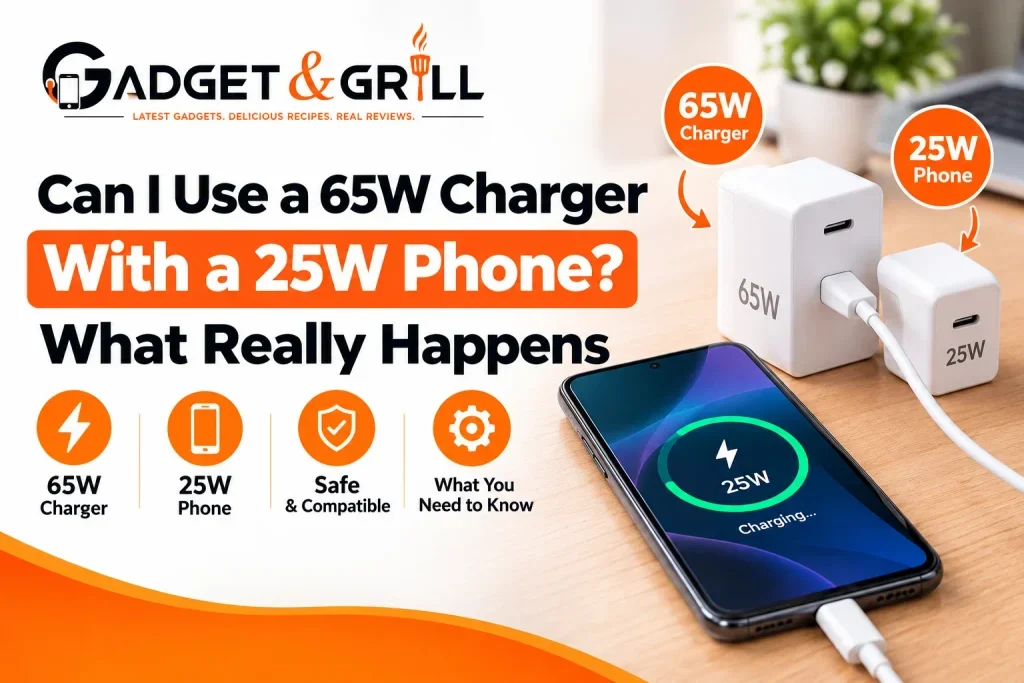
You have a phone that supports 25W charging, but you already own a 65W charger.
The obvious question is:
Can I use the 65W charger with my 25W phone?
Yes, in most cases, you can.
A 65W charger does not force 65W into a 25W phone.
With a compatible charging system, the charger offers its available power and the phone takes the amount it is designed to accept. USB Power Delivery is built around this type of power negotiation. USB IF says USB Power Delivery lets low power devices negotiate for only the power they require.
So, a 25W phone with a 65W charger will normally charge at its own supported rate, such as 25W or lower, not at 65W.
Samsung gives a useful real world example. Its 65W adapter supports up to 65W on one USB C port under supported PD and Super Fast Charging conditions, while another USB C port on the same charger can provide up to 25W. Samsung also states that actual charging speed depends on the connected devices and charging conditions.
The important part is not just the 65W number.
Charger compatibility matters.
Quick Answer
| Question | Answer |
|---|---|
| Can a 65W charger charge a 25W phone? | Yes, in most cases |
| Will the phone receive 65W? | No, not if it only supports 25W |
| Can a compatible 65W charger damage a 25W phone? | Normally no |
| Will a 65W charger make a 25W phone charge faster? | Not beyond the phone’s supported charging rate |
| Does the charging standard matter? | Yes |
| Does the cable matter? | Yes |
| Is USB PD useful? | Yes, for compatible devices |
| Can every 65W charger fast charge every 25W phone? | No |
| Is a higher watt charger always better? | No |
Why Doesn’t a 65W Charger Push 65W Into a 25W Phone?
This is where many people get confused.
A charger rating such as 65W describes the power the charger can provide under supported conditions.
It does not mean every connected device will receive 65W.
A USB PD charger can advertise its available power options. The connected device can then request an appropriate power level. USB IF describes this as power negotiation, including cases where low power devices ask only for the power they need.
Think of the charger as a large water tank.
A small bottle connected to the tank does not suddenly become a large bottle.
The phone controls how much power it takes.
That is why a 65W charger with a 25W phone can be perfectly normal.
What Happens When You Connect a 25W Phone to a 65W Charger?
Assume:
Phone maximum supported charging = 25W
Charger maximum output = 65W
The charger can provide up to 65W.
The phone asks for the power it supports through the charging system.
The result is generally:
Phone receives up to 25W
not:
Phone receives 65W
The actual result can be lower because charging speed also depends on temperature, battery level, cable capability, charging protocol and phone activity.
Samsung states that actual charging speed can vary with usage, charging conditions and connected devices.
Apple provides a similar example on its current support pages. Apple says higher wattage adapters can be used with supported iPhones, while actual power delivered varies by the device, adapter and system conditions.
Can a 65W Charger Damage a 25W Phone?
A compatible, reputable 65W charger should not normally damage a 25W phone simply because its maximum rating is higher.
The important word is compatible.
A genuine USB PD charger is designed to work with devices across different power levels. USB IF specifically describes USB PD as supporting low power devices that negotiate for the amount of power they require.
Google’s Pixel support community gives a clear practical example. Its product expert guidance says a Pixel that supports 18W can use compatible USB PD chargers rated at 30W, 45W, 65W or higher because the phone and charger communicate to optimise charging. Google Help
But this does not mean you should connect any random 65W charger you find online.
Poor quality hardware, faulty accessories and incompatible charging systems can create charging problems.
What Does Charger Wattage Actually Mean?
This is the key idea behind charger wattage explained.
Power is measured in watts.
A simple electrical relationship is:
Power = Voltage × Current
So a charger might provide different combinations of voltage and current.
For example:
5V × 3A = 15W
9V × 2.77A ≈ 25W
20V × 3.25A = 65W
The charger does not need to send one fixed power level all the time.
Modern charging systems can use different voltage and current levels.
USB Power Delivery exists to support flexible power delivery and negotiation between devices. USB IF’s current USB PD documentation covers this system, with the latest specification listed in September 2026.
Does a 65W Charger Make a 25W Phone Charge Faster?
No, not beyond the phone’s supported charging limit.
Suppose your phone supports a maximum of 25W.
Moving from:
25W charger → 65W charger
does not automatically turn the phone into a 65W charging phone.
The phone remains a 25W phone.
You may still see a difference in some cases if the old charger was unable to provide the phone’s full supported charging mode.
For example:
Old charger: 10W
New compatible charger: 65W
Phone: supports 25W
The phone could move from about 10W to up to its supported 25W range.
But:
25W charger → 65W charger
does not mean:
25W charging → 65W charging
The phone remains limited by its own charging system.
Is a Higher Watt Charger Better?
Not always.
A higher watt charger can be useful if you charge several devices or own devices with different power requirements.
For example, one 65W charger can be useful for:
Phone
Tablet
Earbuds
Laptop
provided the charger has the right ports and supported charging standards.
Samsung’s 65W adapter is one example. It can distribute power across multiple devices, with its total output changing according to how many ports are in use. Samsung lists different power combinations for one, two and three connected devices. Samsung it
So a 65W charger may be a better multi device charger even when your phone only needs 25W.
Can I Use a 65W Charger with a Samsung 25W Phone?
In many cases, yes, when the charger supports the Samsung charging system your phone needs.
Samsung’s own 65W adapter supports USB PD 3.0 and PPS, as well as Samsung’s Super Fast Charging system on supported devices. Samsung also sells a 25W adapter based on USB Power Delivery 3.0 with PPS, showing that the charging system matters along with the wattage rating.
However, do not assume every 65W charger will provide Samsung’s fastest 25W charging mode.
The charger needs to support the correct charging protocol.
Samsung says its Super Fast Charging requires a compatible USB PD charger, while specific fast charging modes depend on the phone and charger.
So:
Safe? Usually, with a proper compatible charger.
Full 25W speed? Only when the charging protocol and cable support it.
Can I Use a 65W Charger With an iPhone?
Yes, a higher watt USB C charger can be used with supported iPhones.
Apple’s current support documentation says iPhone can use compatible higher wattage USB C power adapters. Apple also notes that the actual power delivered depends on the iPhone model, adapter and system conditions.
This is another real world example of why:
Charger maximum wattage ≠ power forced into the phone
Apple also warns that charging speed can fall when using low power chargers, hubs or certain other charging setups.
Does USB PD Matter?
Yes, especially when buying a universal USB C charger.
USB Power Delivery is a standard designed to manage power delivery between compatible devices.
USB IF says USB PD allows more flexible power delivery and supports low power devices negotiating for only the power they require. The current USB PD specification supports a wide range of power levels.
This is why you should not judge a charger only by:
65W
Look for the actual charging standards listed in the specifications.
For example:
USB PD
PD 3.0
PPS
Then check if your phone supports the required standard.
What is PPS and Why Does it Matter?
PPS stands for Programmable Power Supply.
It is part of the USB PD ecosystem and allows supported chargers and devices to work with more flexible voltage and current levels.
Samsung uses PD 3.0 and PPS in its 25W and 65W chargers.
This matters because two chargers can both say:
65W
yet provide different charging experiences with a particular phone.
One may support the phone’s preferred charging protocol.
Another may not.
That is why 65W charger safe for phone and 65W charger compatible with phone are two different questions.
Why Does the Charging Cable Matter?
The charger is only one part of the system.
You also have:
Phone
Charger
Cable
The cable needs to support the charging mode you want.
Samsung specifically states that its 65W and 45W modes require a 5A cable in supported configurations.
That does not mean every 25W phone requires a 5A cable.
It means cable capability must match the charging mode.
A 65W charger with a poor or unsuitable cable may not deliver the expected charging performance.
So if your phone charges slowly with a 65W charger, do not blame the charger immediately.
Check the cable.
Does a 65W Charger Need a Special Cable for a 25W Phone?
Not always.
For a phone that actually draws only 25W, the cable requirements depend on the phone’s charging system.
But if you also want to use the same charger for a laptop or another device at higher power, cable capability becomes more important.
This is why people buying a 65W multi device charger should look at the charger and cable as one system.
Samsung’s own specifications show this clearly by stating specific cable requirements for its higher power charging modes.
What If the Charger Is 100W?
The same principle applies.
A 100W charger does not force 100W into a 25W phone.
If the phone supports 25W, the phone remains the limiting factor.
The larger charger can be useful for other devices.
For example:
25W phone
45W tablet
65W laptop
A 100W charger could be useful as a single charger for all three, provided the ports and standards support those devices.
USB PD is designed for this type of flexible power delivery.
What If the Charger Is 120W or 140W?
The same basic idea applies.
A higher maximum rating does not mean the phone automatically receives that power.
But higher wattage makes it even more important to check:
Charging protocol
USB PD support
Cable rating
Port output
Manufacturer compatibility
Charger quality
Do not buy a 140W charger simply because it has a bigger number.
Buy it when you have a reason to use that extra capacity.
What Happens if the Phone Supports 25W but the Charger Is Only 10W?
This is the opposite situation.
The phone will usually charge, but slower.
For example:
Phone: 25W maximum
Charger: 10W maximum
The charger cannot provide the phone’s full 25W charging capability.
You might see:
10W or less
instead of:
Up to 25W
Apple’s current support guidance gives a similar example by noting that lower power wired chargers can result in slower charging.
This is why upgrading from a weak charger to a suitable 25W or compatible higher watt charger can improve charging speed.
What If My 65W Charger Says “Fast Charging” but My 25W Phone Charges Slowly?
This is where compatibility becomes important.
Check these five things:
1. Charging standard
Does the charger support the protocol your phone needs?
2. Cable
Does the cable support the required charging mode?
3. Phone settings
Is fast charging enabled?
4. Temperature
Is the phone too warm?
5. Battery level
Charging can slow as the battery gets closer to full.
Samsung notes that charging speed varies with charging conditions and connected devices. Apple also says temperature, system conditions and heavy phone use can reduce charging speed. Samsung it
Why Does My 25W Phone Sometimes Charge at Less Than 25W?
“25W” usually means the supported maximum under suitable conditions.
It does not mean the phone must stay at 25W throughout the charging session.
Charging power can change based on:
Battery percentage
Temperature
Phone activity
Charger
Cable
Charging standard
Device design
Apple says actual charging speed depends on the charging setup and system conditions. Samsung gives similar guidance.
So seeing less than 25W at some point does not automatically mean something is wrong.
Does a 65W Charger Make the Phone Hotter?
It can, but not simply because the charger is rated at 65W.
If your 25W phone only takes up to its supported charging power, the phone is not suddenly accepting 65W.
Heat depends on the complete charging system and the conditions at the time.
Apple says an iPhone may slow or pause charging when temperature becomes too high. Samsung also says charging speed can change with temperature and charging conditions.
So if your phone becomes unusually hot while charging, investigate the actual condition rather than blaming the charger wattage alone.
Can a Cheap 65W Charger Damage a Phone?
This is a different concern.
The issue is not that the charger says 65W.
The issue is charger quality and compliance.
Avoid chargers with:
No clear manufacturer information
No clear power specifications
Poor build quality
Suspiciously low prices
No recognised safety information
A reputable charger that follows the relevant standards is a much safer choice.
USB IF maintains certification and compliance information for USB products and publishes current USB Type C and USB Power Delivery specifications.
Do not confuse high wattage with poor quality.
They are separate issues.
65W Charger vs 25W Charger for a 25W Phone
Here is the practical comparison.
| Feature | 25W Charger | 65W Charger |
|---|---|---|
| Phone supports 25W | Yes | Yes |
| Maximum charger output | 25W | 65W |
| Phone charging limit | Up to 25W | Up to 25W |
| Expected phone speed | Up to 25W | Up to 25W |
| Automatically faster | No | No |
| Can power larger devices | Limited | Better |
| Useful for laptop charging | Usually no | Often yes |
| Good for multi device use | Limited | Better |
| Safe with compatible phone | Yes | Yes |
The key point
For your 25W phone alone, there may be little benefit in buying a 65W charger purely for faster phone charging.
The 65W charger becomes more useful when you want one charger for several devices.
Can I Use a 65W Charger With a 25W Phone Every Day?
Yes, provided the charger and cable are suitable for the phone.
There is no technical reason you must use a charger whose printed wattage exactly matches the phone’s maximum.
The phone controls its charging power within the supported system.
Google’s Pixel guidance gives a direct example of using chargers rated at 30W, 45W and 65W with a device that requires much less power. Google Help
Samsung also sells 65W adapters that are designed to charge a range of devices, including devices that use 25W charging.
Can I Use the Same 65W Charger for My Phone and Laptop?
This is one of the best reasons to own a 65W charger.
Suppose you have:
25W phone
65W laptop
A 65W charger can be useful for both when the ports and charging standards match.
The phone can take its supported power.
The laptop can take its supported power.
USB Power Delivery was designed to support flexible power delivery across devices such as phones, tablets, laptops and other USB powered products.
This can reduce the number of chargers you carry.
How to Check if a 65W Charger is Compatible with Your 25W Phone
Before connecting the charger, check the following.
Step 1: Check the phone’s charging standard
Look at the phone manufacturer’s specifications.
Do not check only the maximum wattage.
Look for information about:
USB PD
PPS
Super Fast Charging
Quick Charge
or the manufacturer’s own charging technology.
Step 2: Check the charger specifications
Look for the actual output profiles.
For example, Samsung’s 65W charger lists different voltage and current combinations for its USB C ports and different charging modes.
Step 3: Check the cable
Make sure the cable can support the charging mode you want.
Step 4: Check the charging indicator
Your phone may display:
Fast charging
Super fast charging
or a similar message.
The exact wording depends on the manufacturer.
Step 5: Watch the temperature
A little warmth can occur during charging.
Unusual heat needs investigation.
Common Mistakes People Make with Charger Wattage
Mistake 1: Thinking 65W means the phone receives 65W
It does not.
Mistake 2: Buying the highest watt charger available
More wattage is useful only when your devices can make use of it.
Mistake 3: Ignoring charging protocols
A 65W charger can still fail to provide a phone’s fastest charging mode if the required protocol is missing.
Mistake 4: Ignoring the cable
The cable can limit charging performance.
Mistake 5: Assuming every USB C charger is the same
USB C describes the connector and ecosystem. It does not mean every USB C charger supports every charging method.
Google’s Pixel guidance specifically warns that some USB C chargers do not support USB PD.
Mistake 6: Using a damaged charger
Stop using damaged charging equipment.
65W Charger With 25W Phone: Real World Examples
Example 1: Samsung 25W phone + Samsung 65W charger
Compatible charging systems can allow the phone to use up to its supported 25W level. Samsung’s 65W adapter supports PD and PPS and lists 25W output capability on one of its USB C ports. Samsung it
Result: Safe and useful when compatible.
Example 2: Pixel with a supported 65W USB PD charger
Google’s Pixel community guidance says a Pixel requiring 18W can use compatible USB PD chargers rated at 30W, 45W or 65W because the devices communicate to optimise charging. Google Help
Result: Higher charger rating does not force higher power into the phone.
Example 3: iPhone + higher watt USB C charger
Apple states that supported iPhones can use higher wattage USB C adapters, with actual power delivery depending on the iPhone, adapter and system conditions. Apple Support
Result: Higher wattage can be safe when the charging setup is compatible.
Does a 65W Charger Waste Electricity With a 25W Phone?
The charger does not continuously draw 65W simply because its label says 65W.
The 65W rating is the maximum output capability under supported conditions.
Power use depends on how much energy the connected device needs and the efficiency of the charger.
So you do not need to worry that a 25W phone is constantly consuming 65W just because you connected a 65W adapter.
Is a 65W GaN Charger Better for a 25W Phone?
GaN means gallium nitride.
GaN chargers can be smaller and more efficient than many traditional silicon based designs. Samsung describes its 25W adapter as using GaN technology on its India product page. Samsung it
For a 25W phone, GaN does not magically make the phone charge faster.
The main benefits can be:
Smaller charger
Good power density
Useful for multiple devices
Convenient travel size
So choose GaN for the charger design and multi device use, not because your 25W phone needs 65W.
What Should You Buy for a 25W Phone?
There are three sensible options.
Option 1: Buy a 25W charger
Best when you only need to charge the phone.
Option 2: Buy a 45W charger
Useful when you have other devices that need more power.
Option 3: Buy a 65W charger
Best when you want one charger for your phone plus a tablet, laptop or other devices.
The third option gives you more flexibility, but it does not make the 25W phone itself become a 65W phone.
Final Answer
Can I use a 65W charger with a 25W phone?
Yes, in most cases.
A compatible 65W charger can safely charge a phone that supports 25W. The phone does not automatically receive 65W. With a suitable charging system, the phone and charger negotiate the available power and the phone takes the amount it supports. USB IF describes USB Power Delivery as allowing devices to negotiate for the power they require. USB-IF
The real checks are:
Is the charger reputable?
Does it support the phone’s charging protocol?
Does the cable support the required charging mode?
Is the phone operating at a suitable temperature?
Does the phone actually support the charging mode you expect?
So, if your phone supports 25W and you have a good 65W charger, there is normally no reason to avoid using it simply because the charger has a higher wattage rating.
Remember this simple rule:
The charger’s wattage is its maximum capability. The phone decides how much power it uses.
That is the most important point in the entire article.
Frequently Asked Questions
Can a 65W charger damage a 25W phone?
A reputable and compatible charger should not normally damage a 25W phone simply because it can provide up to 65W. USB PD is designed to allow devices to negotiate the power they require.
Can I use a 65W charger with a 25W Samsung phone?
Yes, provided the charger supports the required Samsung charging protocol. Samsung’s own 65W adapter supports USB PD and PPS and can provide 25W charging under supported conditions.
Will a 25W phone charge at 65W?
No. A phone that supports a maximum of 25W will not suddenly become a 65W charging phone because you connect a 65W charger.
Can I use a 100W charger with a 25W phone?
A compatible 100W charger can be used in many cases. The phone still determines the power it accepts.
Can a higher watt charger make my phone charge faster?
Only up to the phone’s own supported charging limit. A higher rated charger can help when your old charger is too weak, but it cannot increase the phone’s hardware charging limit.
Does the cable matter when using a 65W charger?
Yes. The cable must support the charging mode and power level you want. Samsung specifies a 5A cable for some of its 65W and 45W charging modes.
What is USB PD?
USB Power Delivery is a charging standard that enables flexible power delivery between compatible devices. USB IF says devices can negotiate for the power they require.
What is PPS?
PPS stands for Programmable Power Supply. It is used with supported USB PD charging systems to allow more flexible control of charging voltage and current.
Is a 65W GaN charger safe for a 25W phone?
A reputable, compatible GaN charger can be safe. GaN describes the charger technology, not the power that your phone must receive. Samsung uses GaN in some of its current 25W chargers.
Is a 25W charger better than a 65W charger for a 25W phone?
For the phone alone, not necessarily. Both can charge the phone at its supported rate when compatible. A 65W charger has more capacity for other devices.